Surfing & paddleboardingBuying guide
Winter wetsuits for surfing in Spain: 4/3 vs 5/4 compared
Across most of Spain a 4/3 is enough in winter. Six suits compared, and when a 5/4 is really worth it.
As an Amazon Associate I earn from qualifying purchases. Links to Decathlon don't earn a commission at the moment. More information.
Quick answer
Starting out in winter
Decathlon 100 4/3 men's wetsuit
Rated for 12–17 °C, which covers most of mainland Spain in winter, in Decathlon's simplest suit.
If you surf often
Decathlon 900 4/3 men's full suit
Same water range, with a chest zip, GBS seams and 85% natural rubber according to its listing.
Women's fit
Decathlon 500 4/3 women's wetsuit
A women's 4/3 rated for 12–17 °C with a back zip, for surfers who already catch waves.
For the coldest water
Decathlon 900 5/4 hooded men's wetsuit
The only 5/4 with a stated range, 7–12 °C, plus a built-in hood and 3 hours of use claimed.
For winter surfing on most of Spain's coast a 4/3 is enough: according to Puertos del Estado's buoys, from December to March the average sea temperature on the mainland ranges from 12.9 to 16.9 °C, and Rip Curl's thickness chart recommends a 4/3 between 13 and 16 °C. A 5/4 mainly pays off in Galicia and on the Bay of Biscay coast in the coldest weeks, for long sessions or if you feel the cold.
If you're used to UK winter water, Spain's is noticeably milder, so the suit you wear at home may be warmer than you need. We compared six suits from Amazon.es and Decathlon on stated water temperature, zip and seams: three 4/3s, two 5/4s and a 5 mm all-rounder.
6 models compared
Figures from each model's official listing, checked on 21 November 2026. "Not checked" means the listing doesn't give that figure. The current price is in the shop.
| Model | Thickness | Stated temperature | Entry | Seams | For | ||
|---|---|---|---|---|---|---|---|
Starting out in winterDecathlon100 4/3 men's wetsuit |
4/3 mm | 12–17 °C (water) | Back zip | Stitched and glued | Men · beginner | Stated water range: 12–17 °C. | Labelled for beginners. |
If you surf oftenDecathlon900 4/3 men's full suit |
4/3 mm | 12–17 °C (water) | Chest zip | Stitched and glued (GBS) | Men · expert | GBS stitched and glued seams, with internal panels at stress points. | Same stated water range as the 100. |
Women's fitDecathlon500 4/3 women's wetsuit |
4/3 mm | 12–17 °C (water) | Back zip | 'Stretch' (no more detail) | Women · improver | Stated range of 12–17 °C. | Back zip rather than chest zip. |
For the coldest waterDecathlon900 5/4 hooded men's wetsuit |
5/4 mm | 7–12 °C (water) | Chest zip | Stitched, glued and taped | Men · expert | Stated range of 7–12 °C and 3 hours of use. | Labelled for experts. |
O'NeillEpic 5/4 GBS |
5/4 mm (spec table: 4 mm) | Not checked | Back zip | Glued and blind-stitched | Men (not stated on listing) | Glued and blind-stitched seams. | No stated temperature. |
Owntop5 mm front-zip wetsuit |
5 mm in title; 5/4 variant | 10 °C | Front zip | Glued and blind-stitched | Men and women, by variant | States 10 °C. | Title aimed at diving. |
The models in detail
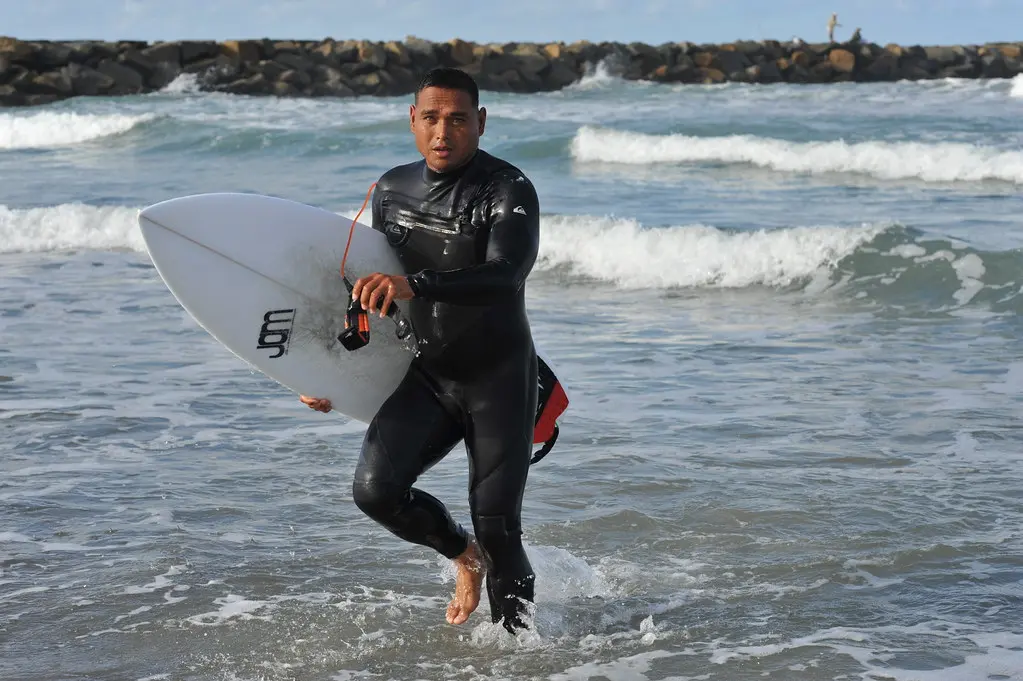
Illustration, not a photo of this model.
Decathlon 100 4/3 men's wetsuit
Why it made the list: Decathlon's most basic 4/3 is rated for the same water range as its high-end suits: 12–17 °C.
- Thickness
- 4/3 mm
- Stated temperature
- 12–17 °C (water)
- Entry
- Back zip
- Seams
- Stitched and glued
- For
- Men · beginner
What we like
- Stated water range: 12–17 °C.
- No seams under the arms or in the crotch, according to the listing.
- Sizes XS to 2XL.
What we don't
- Labelled for beginners.
- Its specifications class it as semi-watertight.
It's for you if you're starting winter surfing and your water is around 13–16 °C, as on most of the Spanish mainland.
Skip it if you often surf in water below 12 °C or do long sessions: that's outside its stated range.
Illustration, not a photo of this model.
Decathlon 900 4/3 men's full suit
Why it made the list: Rated for the same range as the 100, but adds a chest zip, GBS seams and 85% natural rubber, according to its listing.
- Thickness
- 4/3 mm
- Stated temperature
- 12–17 °C (water)
- Entry
- Chest zip
- Seams
- Stitched and glued (GBS)
- For
- Men · expert
What we like
- GBS stitched and glued seams, with internal panels at stress points.
- Diagonal chest zip.
- Tall sizes (MT and LT) as well as S to 2XL.
What we don't
- Same stated water range as the 100.
- Labelled for experts.
It's for you if you surf often in winter, prefer a chest zip or want a suit with plenty of natural rubber.
Skip it if you're a beginner: it's labelled for experts and, on paper, isn't rated for colder water than the 100.
Illustration, not a photo of this model.
Decathlon 500 4/3 women's wetsuit
Why it made the list: Rated for 12–17 °C with a back zip: the women's 4/3 with the fullest figures for regular surfers.
- Thickness
- 4/3 mm
- Stated temperature
- 12–17 °C (water)
- Entry
- Back zip
- Seams
- 'Stretch' (no more detail)
- For
- Women · improver
What we like
- Stated range of 12–17 °C.
- More flexible neoprene in the arms and upper body.
What we don't
- Back zip rather than chest zip.
- The listing only describes the seams as 'stretch seams'.
It's for you if you surf regularly in cool water and prefer a back zip.
Skip it if you want very long sessions or to go below 12 °C: that's outside its stated range.
Illustration, not a photo of this model.
Decathlon 900 5/4 hooded men's wetsuit
Why it made the list: The only 5/4 with a water range in figures, 7–12 °C, plus a built-in hood and 3 hours of use claimed.
- Thickness
- 5/4 mm
- Stated temperature
- 7–12 °C (water)
- Entry
- Chest zip
- Seams
- Stitched, glued and taped
- For
- Men · expert
What we like
- Stated range of 7–12 °C and 3 hours of use.
- Built-in hood, chest zip and reinforced knees and wrists.
What we don't
- Labelled for experts.
- The hood is fixed, so you can't take it off on milder days.
It's for you if you surf in genuinely cold water and want a hood without buying a separate one.
Skip it if your winter water is around 15 °C: you'll have more hood and thickness than you need.
Illustration, not a photo of this model.
O'Neill Epic 5/4 GBS
Why it made the list: The Amazon 5/4 with the most construction detail: glued and blind-stitched seams, a double-sealed neck and a key pocket.
- Thickness
- 5/4 mm (spec table: 4 mm)
- Stated temperature
- Not checked
- Entry
- Back zip
- Seams
- Glued and blind-stitched
- For
- Men (not stated on listing)
What we like
- Glued and blind-stitched seams.
- Double-sealed neck and key pocket.
What we don't
- No stated temperature.
- The listing doesn't make clear who it's cut for.
It's for you if you want a winter suit with a back zip from a surf brand.
Skip it if you need a temperature guide: none is published, and the spec table sums it up as 4 mm.
Illustration, not a photo of this model.
Owntop 5 mm front-zip wetsuit
Why it made the list: States 10 °C and has a front zip, but its title leads with diving and it's sold for men and women: it isn't a surf-specific suit.
- Thickness
- 5 mm in title; 5/4 variant
- Stated temperature
- 10 °C
- Entry
- Front zip
- Seams
- Glued and blind-stitched
- For
- Men and women, by variant
What we like
- States 10 °C.
- Front zip and knee pads.
What we don't
- Title aimed at diving.
- Called 5 mm, while the variant is 5/4.
It's for you if you want a temperature figure and prefer a front zip, for surfing and diving.
Skip it if you want a surf-specific suit: the listing presents it as multi-purpose.
Other options and what we ruled out
- Waterfall Backzip PRO 5/4 and Quiksilver Swell Natural 5/4, Everyday Sessions 5/4/3 and Prologue+ 5/4/3 (on Decathlon.es): Sold by other companies through Decathlon's marketplace; we only link to products sold by Decathlon itself.
- Decathlon men's 4/3 500 surf wetsuit: Its listing marks it as customisable, and customisable products are left out of our guides.
How we chose
Desk research: we compared what the Amazon and Decathlon listings state. We haven't tried these wetsuits or measured how warm they are. We compared six full suits for cold water sold on Amazon.es or directly by Decathlon, checking each official listing on 21 November 2026, and matched their figures against the average winter sea temperature on each coast.
Buying guide: what to look for
Which thickness each coast needs in winter
Using Puertos del Estado's buoy averages (2005–2025) and Rip Curl's thickness chart, from January to March: in Galicia and on the Bay of Biscay coast the water averages 12.9–13.6 °C, which calls for a 4/3 and, in March, a 4/3 or 5/4; in the Levant and Balearic Mediterranean (Valencia, Murcia, Catalonia and the Balearics), 13.8–14.5 °C, a 4/3; in the Strait and Alborán Sea (Costa del Sol), 15.2–15.6 °C, a 4/3; in the Gulf of Cádiz, 16.2–16.9 °C, a 3/2 by the chart or a 4/3 if it's windy or you feel the cold; and in the Canaries, 19.2–20 °C, a 2 mm suit.
Month-by-month detail is in our sea temperature guide.
The stated range tells you more than the price tier
Decathlon's three 4/3s are all rated for the same water range, 12–17 °C, even though they're labelled for different levels. What changes is the entry, the seams, the material and the level they're aimed at. Of the Amazon suits, the Owntop states 10 °C without saying whether that's water temperature, and the O'Neill Epic gives no figure at all. If it's your first suit, read how to choose a surf wetsuit.
Boots, gloves and hood
Rip Curl's chart recommends boots between 13 and 16 °C, boots and gloves between 9 and 13 °C, and a hood below 9 °C. No Spanish coast averages below 9 °C in any month, so a hood is an option for windy days or long sessions rather than a must. Decathlon's 5/4 has a built-in hood that can't be removed.
Seams and zips
In a winter suit, how water gets in matters. The 900 4/3 lists GBS seams, the hooded 5/4 stitched, glued and taped seams, and the Epic glued and blind-stitched seams with a double-sealed neck. A chest zip frees up your back and a back zip is usually easier to get into; no listing shows that either is warmer. Size matters as much as the model: see our wetsuit size guide.
What to expect to pay
- Under €100
- Entry-level 4/3s, such as Decathlon's 100.
- €100 to €180
- Mid-range and high-end 4/3s, with better seams or a chest zip.
- Over €180
- Hooded 5/4s, such as Decathlon's 900 (list price without promotions).
Rough ranges based on what we saw in Spanish shops on the review date. Prices change often, so always check the shop.
What to choose for your situation
- New to winter surfing on the Mediterranean, Costa del Sol or northern coast
- Decathlon's 100, for its stated 12–17 °C range.
- You surf every week all winter
- The 900 4/3, for its chest zip and GBS seams.
- Galicia or the Bay of Biscay coast on the coldest days, or long sessions
- Decathlon's hooded 5/4, or the O'Neill Epic if you prefer a back zip.
- Women who already catch waves
- The women's 500 4/3, checking the size against its chart.
Common mistakes
- Buying a 5/4 for the Mediterranean: its winter average sits in 4/3 territory.
- Choosing by price tier rather than range: Decathlon's three 4/3s are rated for the same water range.
- Buying a '5 mm' suit without checking which variant you've selected.
- Forgetting boots: Rip Curl's chart already recommends them below 16 °C.
Verdict: which should you get?
If you're starting out: Decathlon's 100 4/3 covers winter on most of the mainland, going by its stated range.
If you surf often: the 900 4/3, with the catch that it's labelled for experts.
If you surf the north in midwinter or do long sessions: the hooded 5/4.
What we don't know: how each temperature range was worked out, whether these suits are warm enough in your conditions, or which sizes are in stock.
Buying in Spain
- Canary Islands, Ceuta and Melilla: they're outside the EU VAT area, so Amazon.es doesn't charge VAT there, but orders can be subject to local import or customs charges, take longer to arrive and need a Spanish tax ID (NIF) in the delivery address. Each seller also sets its own shipping restrictions, so check before you order.
- If you're staying in a hotel or holiday let, ask reception before using it as your delivery address, or choose an Amazon Locker or pick-up point when you check out.
- Sizes on Spanish listings are usually EU sizes. Check the brand's own size chart rather than assuming your UK size converts directly.
- For a week's holiday, hiring locally can work out better than buying, especially for boards and kayaks. Bulky kit also costs extra to fly home.
FAQs
Is a 4/3 enough for winter in Spain?
On most of the Spanish coast, yes: from December to March the mainland sea averages 12.9–16.9 °C, and Rip Curl's chart recommends a 4/3 between 13 and 16 °C. In Galicia and on the Bay of Biscay coast, in the coldest weeks, you may want a 5/4.
Do I need a hood?
Rip Curl's chart only adds one below 9 °C, and no Spanish coast averages that low in any month. Some surfers wear one in cold wind or for long sessions: it's a personal choice.
What about the Canary Islands?
With winter averages of 19–20 °C, Rip Curl's chart suggests a 2 mm suit. A 4/3 will usually be too warm.
Sources
- Decathlon men's 100 4/3 surf wetsuit listing (Decathlon, in Spanish)
- Decathlon men's 900 4/3 surf wetsuit listing (Decathlon, in Spanish)
- Decathlon women's 500 4/3 surf wetsuit listing (Decathlon, in Spanish)
- Decathlon men's hooded 900 5/4 surf wetsuit listing (Decathlon, in Spanish)
- O'Neill Epic 5/4 listing (Amazon.es, in Spanish)
- Owntop 5 mm wetsuit listing (Amazon.es, in Spanish)
- Marine climate indicators: daily mean sea temperature (Puertos del Estado, in Spanish)
- Wetsuit Temperature & Thickness Guide (Rip Curl)
General guidance only. Always check the manufacturer's figures and the local rules where you are. See our legal notice.