Beach tennisHow to choose
How to choose a beach tennis racket
Carbon or fibreglass, weight and balance: which racket suits your level.
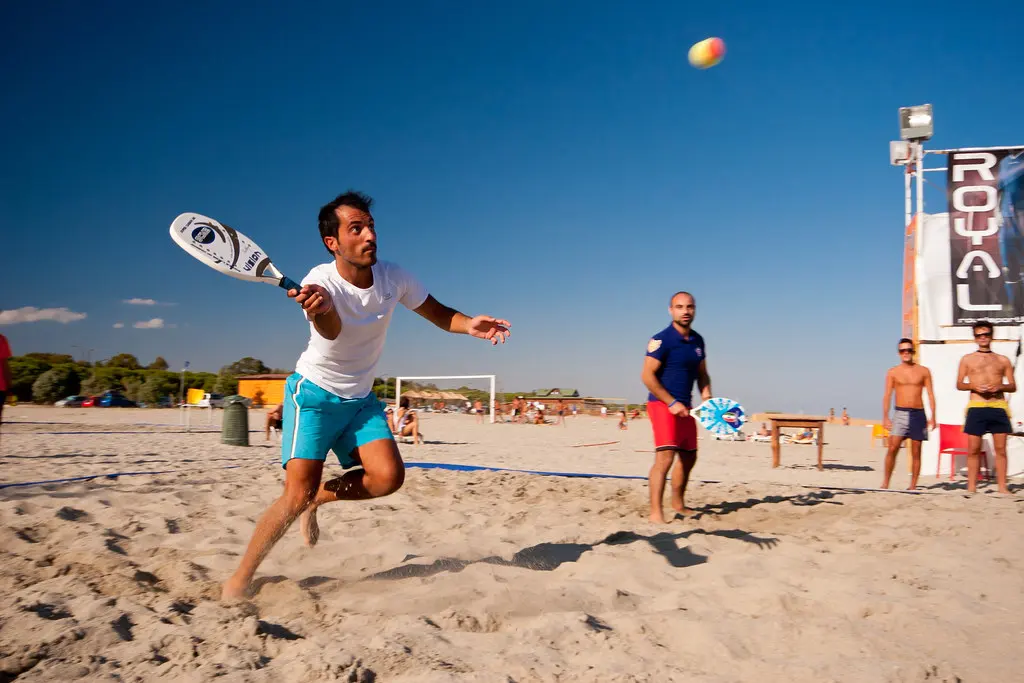
Beach tennis rackets come covered in acronyms, but choosing one comes down to material (fibreglass or carbon), weight and balance. Each gains you something and costs you something, so the question is what your game is missing, not which racket costs the most.
This is general guidance. If you can, try a playing partner's racket before you buy, or hire one for a session if a beach club near you offers that.
This guide explains types and criteria using public information; it doesn't recommend specific models. How we work.
Types compared
| Type | Best for | Main strength | Watch out for |
|---|---|---|---|
| Fibreglass | Starting out and occasional play | Comfortable feel | Less power from the back of the court |
| Carbon | Regular play | More power and response | Harsher feel if you're a beginner |
| Two-racket set | Couples and families starting out | Ready to play | Generally more basic than rackets sold individually |
| Lightweight control racket | Net play and long matches | Reacts quickly at the net | Less punch from the back of the court |
Each type explained
Fibreglass
Best if you want: Starting out and occasional play
More flexible and more forgiving on off-centre shots.
Pros
- Comfortable feel
Watch out for
- Less power from the back of the court
Carbon
Best if you want: Regular play
Stiffer and more responsive. How it feels depends a lot on the core, not just on the weave number.
Pros
- More power and response
Watch out for
- Harsher feel if you're a beginner
Two-racket set
Best if you want: Couples and families starting out
Two rackets and balls, so you can play from day one.
Pros
- Ready to play
Watch out for
- Generally more basic than rackets sold individually
Lightweight control racket
Best if you want: Net play and long matches
Easier to manoeuvre for quick volleys, and less tiring on the arm.
Pros
- Reacts quickly at the net
Watch out for
- Less punch from the back of the court
How to choose
Carbon or fibreglass
Carbon usually gives more power and stiffness, at the cost of a harsher feel. Fibreglass is more flexible and forgiving, which suits beginners. Numbers like 3K, 12K or 18K describe the type of carbon weave; each manufacturer pairs them with different cores, so on their own they aren't a measure of quality.
Weight and balance
A light racket is quicker and less tiring; a heavier one delivers more power but puts more strain on the arm. Head-heavy balance adds punch, handle-heavy balance adds control. If you have elbow or shoulder pain, get advice from a professional and put comfort first.
If you compete: what the rules say
The rules of the International Tennis Federation (ITF), which governs beach tennis, ban strung rackets and set a maximum of 50 cm in length and 26 cm in head width (2023 edition). Balls must be low-compression Stage 2 balls. A doubles court is 16 × 8 m, and the net is set at 1.7 m for women's, mixed and junior events and 1.8 m for men's events. Check the current edition and the tournament's own rules.
Buying in Spain
- Canary Islands, Ceuta and Melilla: they're outside the EU VAT area, so Amazon.es doesn't charge VAT there, but orders can be subject to local import or customs charges, take longer to arrive and need a Spanish tax ID (NIF) in the delivery address. Each seller also sets its own shipping restrictions, so check before you order.
- If you're staying in a hotel or holiday let, ask reception before using it as your delivery address, or choose an Amazon Locker or pick-up point when you check out.
- Sizes on Spanish listings are usually EU sizes. Check the brand's own size chart rather than assuming your UK size converts directly.
- For a week's holiday, hiring locally can work out better than buying, especially for boards and kayaks. Bulky kit also costs extra to fly home.
Verdict: which should you get?
If you're starting out: fibreglass or a two-racket set. If you play every week: medium-stiffness carbon. If you spend a lot of time at the net: a lightweight racket.
It isn't worth buying the stiffest racket to start with. And to play on any beach, see what to look for in a portable net: check its height can be set for beach tennis.
For bright days on the sand, read how to choose sports sunglasses.
FAQs
Can I use a padel racket?
It isn't ideal: padel rackets are designed for a different game and feel different. And in competition, your racket has to meet the beach tennis rules on size.
Which racket should I buy if I've never played?
A fibreglass racket or a beginner's set. Once you're playing regularly, consider carbon.
Sources
General guidance only. Always check the manufacturer's figures and the local rules where you are. See our legal notice.