Surfing & paddleboardingFor beginners
How to choose your first surfboard
Soft-top, transition board or foam longboard: which type to choose for your first waves.
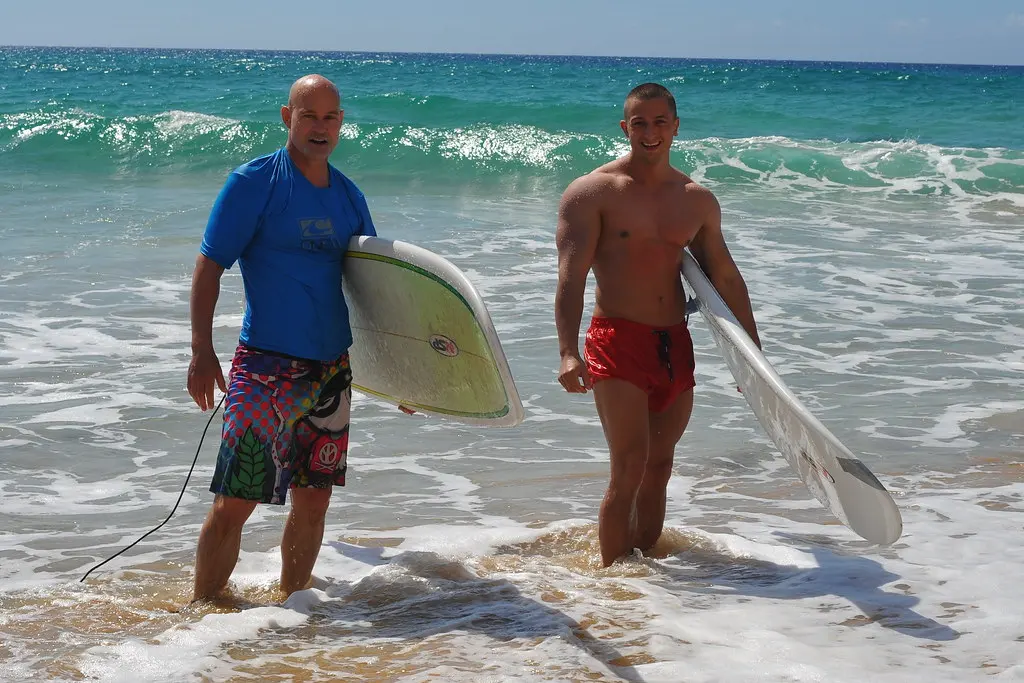
If you've never surfed, start on a soft-top with plenty of volume. A board that's too short floats poorly, is hard to paddle and catches fewer waves; volume and stability help you learn, even if that same board turns less well later. That's the real decision: easy now, or room to progress.
We don't give fixed sizes because they depend on your weight, your fitness and your local waves. If you're having lessons, ask which board you're learning on: it's your best reference. On a surf holiday, using or hiring the school's boards lets you find the right format without risking money.
This guide explains types and criteria using public information; it doesn't recommend specific models. How we work.
Types compared
| Type | Best for | Main strength | Watch out for |
|---|---|---|---|
| Soft-top (foam board) | Your first sessions | Forgiving of mistakes | Falls short once you start manoeuvring |
| Transition board (mini-mal or funboard) | Surfers who can stand up and want to turn | Gives you room to progress | More easily damaged by knocks |
| Foam longboard | Small waves and heavier surfers | Makes small waves easier to catch | Bulky to carry and store |
| Kids' soft-top | Children and teenagers, with supervision | Light and manageable for them | Outgrown as they get bigger |
Each type explained
Soft-top (foam board)
Best if you want: Your first sessions
Soft and very buoyant, and widely used for learning. It's kinder if it hits you, although a foam board can still hurt.
Pros
- Forgiving of mistakes
- Hits less hard than a hard board
Watch out for
- Falls short once you start manoeuvring
Transition board (mini-mal or funboard)
Best if you want: Surfers who can stand up and want to turn
The step in between: it keeps enough volume to paddle and turns more easily than a long soft-top.
Pros
- Gives you room to progress
Watch out for
- More easily damaged by knocks
- Less forgiving at the start
Foam longboard
Best if you want: Small waves and heavier surfers
Lots of buoyancy and stability for getting to your feet. It's heavy and bulky, so think about how you'll transport it.
Pros
- Makes small waves easier to catch
Watch out for
- Bulky to carry and store
- Harder to get out through the breaking waves
Kids' soft-top
Best if you want: Children and teenagers, with supervision
Proportions suited to their weight and reach, with soft rails and fins depending on the model.
Pros
- Light and manageable for them
Watch out for
- Outgrown as they get bigger
How to choose
Soft-top or hard board
Foam copes better with the knocks of learning and is kinder to you and anyone nearby. A hard board responds better and is usually lighter, but it gets damaged sooner and hits harder. If in doubt, start soft.
Length and volume
Volume, in litres, tells you how much a board floats. For the same body weight, more litres mean more stability and easier paddling, and less ability to turn. There are rules of thumb linking litres to kilos, but they're only approximations: use them to rule out the extremes and confirm with your school or shop.
Leash, wax and fins
The leash keeps the board close to you and stops it becoming a hazard to others, but it isn't a lifesaving device. Hard boards need wax or a grip pad; many soft-tops already have a non-slip deck. Check whether fins and a leash are included.
Buy, hire or wait
If you haven't had lessons yet, hiring or learning on the school's board will show you which format suits you without risking money. Buying pays off once you'll surf regularly and know your waves. To make it last, follow how to protect your kit from salt water.
Safety
Start at a lifeguarded beach with small waves, and ask where the currents are. The RNLI advises always wearing a leash and not pushing yourself too soon. If a rip current pulls you out, don't fight it head-on: stay on your board and paddle parallel to the beach to get out of it before heading back in.
Buying in Spain
- Canary Islands, Ceuta and Melilla: they're outside the EU VAT area, so Amazon.es doesn't charge VAT there, but orders can be subject to local import or customs charges, take longer to arrive and need a Spanish tax ID (NIF) in the delivery address. Each seller also sets its own shipping restrictions, so check before you order.
- If you're staying in a hotel or holiday let, ask reception before using it as your delivery address, or choose an Amazon Locker or pick-up point when you check out.
- Sizes on Spanish listings are usually EU sizes. Check the brand's own size chart rather than assuming your UK size converts directly.
- For a week's holiday, hiring locally can work out better than buying, especially for boards and kayaks. Bulky kit also costs extra to fly home.
Verdict: which should you get?
If you've never surfed: a soft-top with plenty of volume. If you can stand up and want to turn: a transition board. For small waves or if you're heavier: a foam longboard, if you can transport it.
It may not be worth buying yet if you haven't tried a few lessons. And before ordering a wetsuit, read how to get your wetsuit size right.
If the water's cold, carry on with how to choose a surf wetsuit.
FAQs
Which board should I buy if I've never surfed?
A soft-top with plenty of volume for your weight. If you're having lessons, ask your instructor to guide you on size.
Is a soft-top fine in winter?
Yes. The board doesn't depend on the temperature; what changes is the wetsuit you need.
Sources
General guidance only. Always check the manufacturer's figures and the local rules where you are. See our legal notice.